
>Article
What Are the Top Enterprise AI Agents for Knowledge Management?

Kishore Kannan
April 18, 2026
The top enterprise AI agents for knowledge management are Glean (best for cross-app knowledge search), Microsoft 365 Copilot with SharePoint Knowledge Agent (best for Microsoft-centric organizations), Google Gemini Enterprise (best for broad enterprise search and agent orchestration), Atlassian Rovo (best for engineering and product teams on the Atlassian stack), and ServiceNow (best for knowledge embedded in service delivery workflows). The best choice depends on where your organization's knowledge already lives and whether your primary problem is discovery, search, or knowledge-embedded workflow execution.
1. Glean — Best Overall for Enterprise Knowledge Search
Glean is built specifically around enterprise knowledge: combining AI-powered search across all workplace apps, permissions-aware retrieval, and an agent-building layer that allows organizations to create custom knowledge agents grounded in their specific content. It connects knowledge across a company's entire application landscape and provides real-time, accurate answers to employee questions regardless of where the source information lives.
-
 Best for: organizations whose primary problem is 'knowledge is everywhere and
employees can't find it'
-
Strength: broad application connectors, permissions-aware search, Glean Agents
for custom knowledge workflows, strong enterprise security
-
Choose Glean if: your knowledge management challenge is cross-app search
and employee self-service
2. Microsoft 365 Copilot + SharePoint Knowledge Agent
Microsoft says every SharePoint site can have an agent, making SharePoint content directly queryable through Copilot. The Knowledge Agent in SharePoint is designed to enrich and organize content for reliable Copilot responses. For organizations whose knowledge lives primarily in SharePoint, Teams, and Microsoft 365, this is the most natural integration point.
-
Best for: Microsoft-centric enterprises with SharePoint as the primary knowledge
repository
-
Strength: native Microsoft integration, broad M365 workflow connection, no new
platform to deploy
-
Choose Microsoft if: your organization already uses SharePoint extensively and
wants knowledge agents without changing platforms
-
Important note: SharePoint Knowledge Agent features were in public preview as of
2025; verify current availability for your tenant and license
3. Google Gemini Enterprise — Best for Google Cloud Organizations
Google Gemini Enterprise is positioned as a unified intranet search, AI assistant, and agentic platform. It supports broad connectors to Confluence, Jira, SharePoint, and ServiceNow, and includes customizable RAG agents grounded on enterprise data with a no-code agent builder. Strong for organizations wanting a comprehensive enterprise search layer on top of Google Cloud infrastructure.
-
.Best for: organizations running on Google Cloud who want broad enterprise
search and agent orchestration
-
Strength: wide third-party connectors, no-code agent builder, strong search
across Google Workspace
-
Choose Google if: your primary infrastructure is Google Cloud and you want an
integrated search + agent platform
4. Atlassian Rovo — Best for Product and Engineering Knowledge
Atlassian Rovo combines Search, Chat, Agents, and Studio specifically designed for organizations whose operational knowledge centers in Jira and Confluence. It uses approved organizational knowledge and connected third-party apps as its source material, and is particularly effective for product, engineering, and IT organizations that already run on Atlassian.
-
Best for: companies where Confluence is the knowledge hub and Jira is where
work happens
-
Strength: native Atlassian integration, strong for technical and product team
knowledge
-
Choose Rovo if: your most critical knowledge lives in Confluence and Jira, and
your users are primarily technical teams
5. ServiceNow — Best for Service-Embedded Knowledge
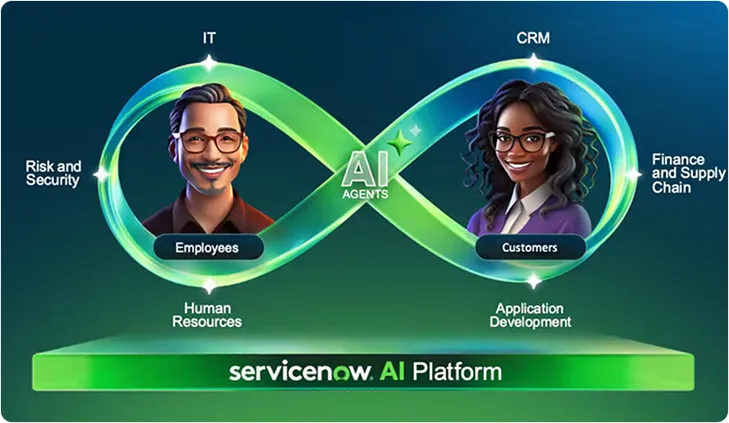
ServiceNow's knowledge management strength is not universal workplace search — it is knowledge embedded in service operations. Its AI Search and employee/service products are designed around knowledge that must drive action: routing service requests, resolving ITSM tickets, answering HR queries, and executing customer service workflows. It is the strongest option when knowledge management is tightly coupled to service delivery.
-
Best for: IT, HR, and customer service teams where knowledge must drive workflow
actions, not just discovery
-
Strength: tight integration with ITSM/HRSM workflows, strong for service delivery
use cases
-
Choose ServiceNow if: your knowledge management is fundamentally about
powering service execution, not general employee discovery
Other Notable Platforms
Guru (proactive in-workflow knowledge delivery, strong Slack and Teams integration), Bloomfire (AI-powered knowledge sharing with smart content recommendations), and Atlassian Confluence with AI (collaborative workspace with AI summarization and search) are strong alternatives depending on team size and budget.
Frequently asked questions
Published Articles
Why Do Enterprises Struggle to Use AI Agents Effectively?
What Causes Data Retrieval Agents to Miss Important Insights?
How Do Conversational AI Agents Improve Decision Making with Unstructured Data?
Which AI Agents Are Best for Enterprise Data Analysis?
What Is the Best Conversational AI Agent for Sales Teams?
Which AI Data Agents Help Enterprises Unlock Insights from Documents?
What Are the Top Enterprise AI Agents for Knowledge Management?
Which Generative AI Agents Streamline Internal Workflows Across Large Companies?
What Is the Best AI Agent Platform for Unstructured Data?
Which AI Agents Enable Human-Like Dialogue Over Company Data?
What is No-Code Precision AI?
Best Conversational AI Sales Agents Compared
See Ragworks in action
Stop guessing. Simulate your entire outbound playbook before hitting send.
Watch demoThere is more
to discover
Read relevant article about AI, Ragworks and our
Founders. You can also find more article on our article

April 1, 2026
Why Do Enterprises Struggle to Use AI Agents Effectively?
Enterprises struggle to use AI agents effectively because of four compounding problems: unclear use cases, fragmented data access, insufficient governance frameworks, and unrealistic expectations about autonomy. The technology is rarely the limiting factor. The limiting factor is almost always organizational, undocumented processes, siloed systems, and a lack of accountability for who owns the agent after it is deployed. Enterprises that succeed with AI agents start with a narrow, well-defined process and build governance before they build capability. Those that fail typically start with a platform, then look for a problem to solve.

April 3, 2026
What Causes Data Retrieval Agents to Miss Important Insights?
Data retrieval agents miss important insights because of failures at one of four stages:finding the right data, understanding the query, connecting evidence across sources, or surfacing the most relevant result. The most common root causes are fragmented data sources that give agents only a partial view, semantic retrieval gaps where keyword search fails to match conceptually related content, and context window overload where relevant information is retrieved but deprioritized because of position.These are not random failures. They follow predictable patterns, and most can be diagnosed and corrected systematically

April 6, 2026
How Do Conversational AI Agents Improve Decision Making with Unstructured Data?
Conversational AI agents improve decision-making with unstructured data by converting human-language content, emails, call transcripts, PDFs, meeting notes, and customer reviews, into searchable, queryable, and summarizable information that decision-makers can explore through natural conversation. Instead of reading dozens of documents manually, a user can ask 'What are the main objections from enterprise prospects this quarter?' and receive a synthesized answer with source references in seconds.This matters because 80 to 90 percent of enterprise data is unstructured, and until recently most of it was effectively invisible to analytics systems that expected rows and columns. Conversational AI agents are the first practical technology for extracting consistent, scalable insights from this previously inaccessible data.