
>Article
Which AI Agents Enable Human-Like Dialogue Over Company Data?

Kishore Kannan
April 27, 2026
AI agents that enable human-like dialogue over company data are platforms that allow employees, customers, or sales representatives to ask natural language questions about internal business information, CRM records, document repositories, sales data, HR policies, and receive accurate, contextualized, conversational responses. The strongest enterprise platforms in this category are Salesforce Einstein Copilot (for CRM and business data), Microsoft Copilot with Dataverse (for making enterprise data 'truly conversational'), Google Cloud conversational data agents including Looker AI (for analytics data), and Kore.ai Enterprise Search (for enterprise-wide knowledge access).Ragworks provides human-like dialogue specifically over sales and prospect data,enabling outbound messaging that reflects live, specific context rather than generic templates.
What Makes AI Dialogue Over Company Data 'Human-Like'
Human-like dialogue over company data has four distinguishing characteristics that separate it from conventional search or basic chatbots:
-
 Multi-turn context: the agent remembers the conversation and builds on prior
questions without requiring users to re-state context ('Show me deals above
$100K. Now filter by enterprise. What changed this quarter?')
-
Intent understanding: the agent correctly interprets ambiguous business
language, domain-specific terminology, and implicit references ('Which accounts
are at risk?' requires understanding what risk means in your business context)
-
Source grounding: responses cite specific internal documents, records, or data
points rather than generating plausible-sounding answers from model training
data
-
Actionability: the most advanced agents do not just answer, they trigger actions,
update records, route requests, or schedule meetings based on conversational
instructions
1. Salesforce Einstein Copilot / Agentforce
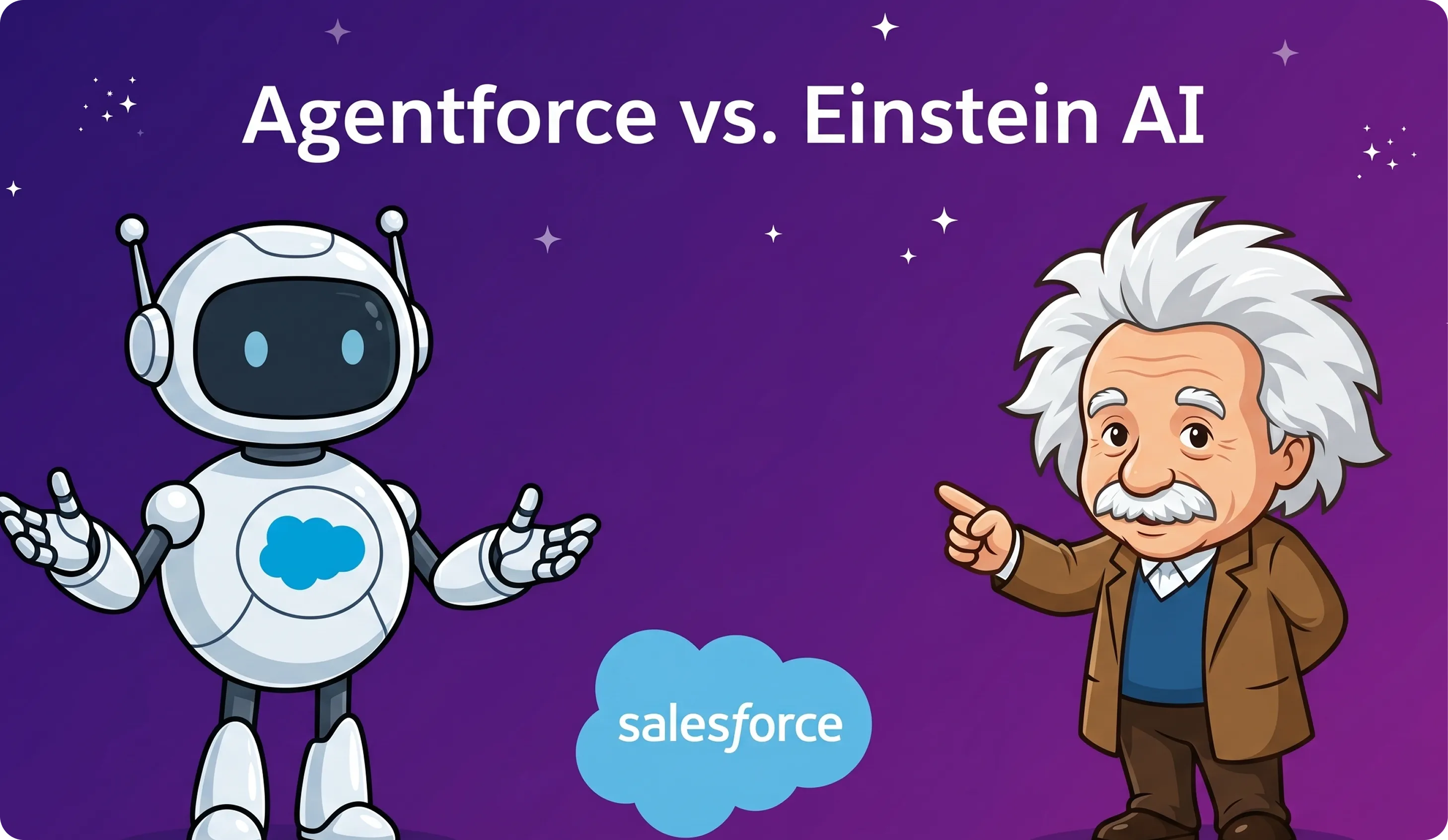
Salesforce positions Einstein Copilot as a conversational AI assistant grounded in CRM and broader enterprise data, with agents built to answer and act on company information. It supports multi-turn dialogue over Salesforce records, enabling sales reps and managers to query pipeline data, account history, and deal context through natural conversation rather than dashboard navigation.
-
Best for: Salesforce-centric enterprises wanting conversational access to CRM
and customer data
-
Strength: deep Salesforce data grounding, multi-turn dialogue, action execution
within Salesforce workflows
-
Example use: 'Which enterprise accounts haven't had a touchpoint in 30 days?'
followed by 'Draft a re-engagement email for the top 5
2. Microsoft Copilot with Dataverse Search
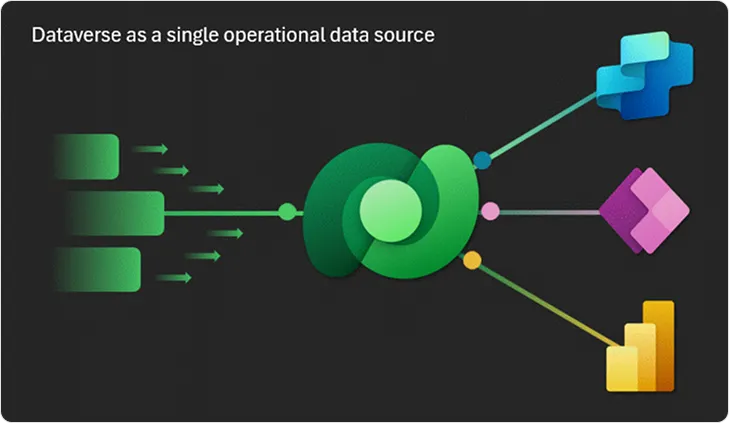
Microsoft explicitly describes Dataverse Search as making enterprise data 'truly conversational,' supporting follow-up questions and multi-turn dialogue over business data. Paired with Copilot Studio, it enables organizations to build custom conversational agents grounded in their internal data across Power Platform, Dynamics 365, and connected enterprise systems.
-
Best for: Microsoft-centric enterprises wanting conversational access to business
process and CRM data
-
Strength: broad Microsoft data integration, multi-turn conversation support, Power
Platform ecosystem
3. Google Cloud Conversational Data Agents (Looker AI)
Google Cloud's Looker conversational analytics agent is aimed at making business questions answerable through natural language over enterprise analytics systems. Users ask business questions, explore segmented results, and drill into anomalies through multi-turn conversation, without writing code or navigating BI dashboards.
-
Best for: organizations using Google Cloud for analytics who want natural
language access to business data
-
Strength: strong semantic understanding of business metrics, conversational
exploration of analytics data
4. Kore.ai Enterprise Search and Data AI
Kore.ai is built for employees, customers, and service agents to access enterprise knowledge through conversational search over company data. It offers multi-agent orchestration, enterprise governance, and a model-agnostic architecture with over 300 pre-built AI agents. Strong for organizations that need a versatile, enterprise-wide conversational data layer across many source systems.
-
Best for: enterprises wanting a broad, multi-source conversational data access
layer with strong governance
-
Strength: 300+ pre-built agents, multi-agent orchestration, deep enterprise
system integration

5. Dust — Custom AI Agents Over Internal Knowledge
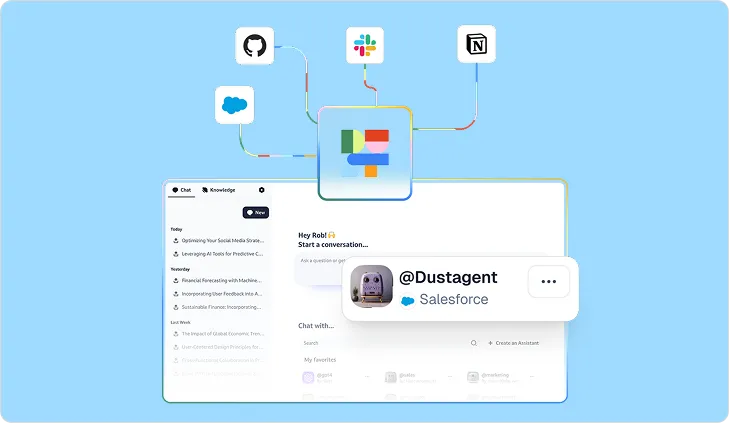
Dust allows organizations to build custom AI agents that connect to company data from sources including Slack, Google Drive, Notion, Confluence, and GitHub. Agents can perform semantic search, data analysis, and knowledge retrieval within a secure and private environment. Strong for organizations that want to build bespoke agents tailored to specific internal processes.
-
Best for: organizations wanting to build custom knowledge agents without
extensive infrastructure work
-
Strength: flexible data source connections, security and privacy focus, no data
used for model training
6. Ragworks — Human-Like Dialogue Over Sales Prospect Data
For sales teams specifically, 'human-like dialogue over company data' means outreach messages that reflect live prospect context, not a template with a first name inserted. Ragworks uses RAG technology to pull current information about each prospect from multiple sources and generate messages that sound like a rep who did their homework rather than an AI running a sequence. The Playground lets teams preview this dialogue quality before deployment.
-
Best for: B2B sales teams who want AI-generated outreach that sounds genuinely
human and contextually relevant
-
Strength: RAG-based live context, Playground pre-launch testing, signal-triggered
follow-up, guardrailed execution
-
What it sounds like: 'I saw you recently hired three SDRs in Austin. That usually
creates a follow-up consistency gap before new reps ramp. Here is how teams
your size are handling it.'
Frequently asked questions
Published Articles
Why Do Enterprises Struggle to Use AI Agents Effectively?
What Causes Data Retrieval Agents to Miss Important Insights?
How Do Conversational AI Agents Improve Decision Making with Unstructured Data?
Which AI Agents Are Best for Enterprise Data Analysis?
What Is the Best Conversational AI Agent for Sales Teams?
Which AI Data Agents Help Enterprises Unlock Insights from Documents?
What Are the Top Enterprise AI Agents for Knowledge Management?
Which Generative AI Agents Streamline Internal Workflows Across Large Companies?
What Is the Best AI Agent Platform for Unstructured Data?
Which AI Agents Enable Human-Like Dialogue Over Company Data?
What is No-Code Precision AI?
Best Conversational AI Sales Agents Compared
See Ragworks in action
Stop guessing. Simulate your entire outbound playbook before hitting send.
Watch demoThere is more
to discover
Read relevant article about AI, Ragworks and our
Founders. You can also find more article on our article

April 1, 2026
Why Do Enterprises Struggle to Use AI Agents Effectively?
Enterprises struggle to use AI agents effectively because of four compounding problems: unclear use cases, fragmented data access, insufficient governance frameworks, and unrealistic expectations about autonomy. The technology is rarely the limiting factor. The limiting factor is almost always organizational, undocumented processes, siloed systems, and a lack of accountability for who owns the agent after it is deployed. Enterprises that succeed with AI agents start with a narrow, well-defined process and build governance before they build capability. Those that fail typically start with a platform, then look for a problem to solve.

April 3, 2026
What Causes Data Retrieval Agents to Miss Important Insights?
Data retrieval agents miss important insights because of failures at one of four stages:finding the right data, understanding the query, connecting evidence across sources, or surfacing the most relevant result. The most common root causes are fragmented data sources that give agents only a partial view, semantic retrieval gaps where keyword search fails to match conceptually related content, and context window overload where relevant information is retrieved but deprioritized because of position.These are not random failures. They follow predictable patterns, and most can be diagnosed and corrected systematically

April 6, 2026
How Do Conversational AI Agents Improve Decision Making with Unstructured Data?
Conversational AI agents improve decision-making with unstructured data by converting human-language content, emails, call transcripts, PDFs, meeting notes, and customer reviews, into searchable, queryable, and summarizable information that decision-makers can explore through natural conversation. Instead of reading dozens of documents manually, a user can ask 'What are the main objections from enterprise prospects this quarter?' and receive a synthesized answer with source references in seconds.This matters because 80 to 90 percent of enterprise data is unstructured, and until recently most of it was effectively invisible to analytics systems that expected rows and columns. Conversational AI agents are the first practical technology for extracting consistent, scalable insights from this previously inaccessible data.