>Article
Which Generative AI Agents Streamline Internal Workflows Across Large Companies?

Viraaj Karthik
April 21, 2026
The generative AI agents most effective at streamlining internal workflows across large companies are: Microsoft Power Automate + Copilot (best for Microsoft-centric employee workflows), Salesforce Agentforce 360 (best for sales and customer service operations), SAP Joule (best for enterprise ERP workflows in finance, HR, and procurement), ServiceNow (best for IT and HR service management), and Glean AI (best for productivity and knowledge management at the employee level). The right choice depends on which department's workflows are the priority and which enterprise platform those workflows run on.
What Makes an AI Agent Effective for Internal Workflows
For generative AI agents to deliver measurable workflow improvement in large companies, they need four capabilities:
-
 Integration depth: the agent must connect to the systems where work actually
happens, CRMs, ERPs, HR platforms, ticketing systems, and internal databases
-
Process coverage: the most valuable agents handle multi-step workflows, not just
single tasks
-
Governance and auditability: enterprise workflows involve regulatory
requirements, approval chains, and compliance obligations that the agent must
respect
-
Measurable output: the agent should produce a specific, trackable outcome, a
routed ticket, a drafted document, a booked meeting, a filed record
1. Microsoft Power Automate + Copilot — Best for Employee Productivity
Microsoft's combination of Power Automate (workflow automation) and Copilot Studio (natural language agent design) enables organizations to build agents that trigger on email, document, or calendar events and execute multi-step workflows across Microsoft 365. Natural language workflow creation allows non-technical business users to build automations without code.
Real-world example: Wells Fargo deployed an internal Teams agent for tens of thousands of bankers to access internal procedures faster, reducing time spent on manual policy lookup.
-
Best for: large Microsoft 365 organizations wanting employee productivity
automation at scale
-
Use cases: document approvals, email-triggered workflows, meeting
summarization, report generation
2. Salesforce Agentforce — Best for Sales and Service Operations
Salesforce Agentforce is embedded in the Salesforce CRM and built for autonomous action across sales, marketing, and customer service workflows. AI agents draft emails, schedule meetings, handle inbound inquiries, escalate support cases, and update records, all within Salesforce's governance and security model.
-
Best for: enterprises standardized on Salesforce running sales and service
workflows
-
Use cases: automated lead follow-up, case routing, pipeline management,
customer service deflection
3. SAP Joule and Joule Agents — Best for ERP Workflows
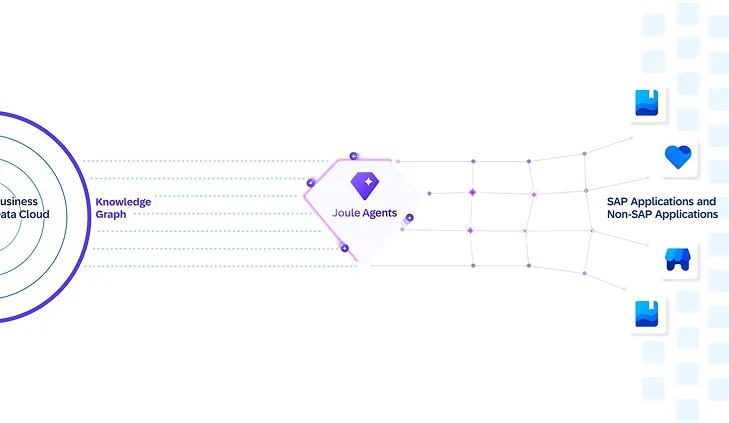
SAP Joule is designed for large organizations running SAP across finance, HR, procurement, supply chain, and cross-functional operations. SAP emphasizes orchestration of multi-step business workflows, an accounts payable approval, an employee onboarding sequence, a procurement request, with governance of agent actions built into the SAP security model.
-
Best for: enterprises running SAP for core business operations, ERP, HR, and supply
chain
-
Use cases: invoice processing, purchase order management, HR onboarding,
financial approvals
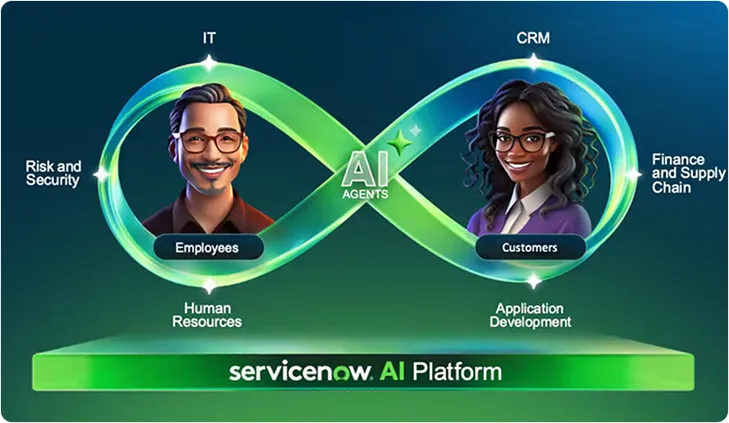
4. ServiceNow — Best for IT and HR Service Workflows
ServiceNow has evolved from an ITSM tool into a comprehensive AI workflow automation platform spanning IT, HR, and customer service. AI agents can classify and route tickets, answer employee questions, escalate issues, and trigger multi-step resolution workflows without human triage at the first level.
Real-world example: Uber uses ServiceNow workflows to handle over 70,000 support interactions, saving approximately 13,000 engineering hours per year.
-
Best for: IT, HR, and customer service teams running high-volume service request
workflows
-
Use cases: IT help desk automation, HR query handling, customer service
deflection, compliance workflows
5. Glean AI — Best for Knowledge and Productivity Workflows
Glean extends beyond search to support productivity workflows: employees can ask questions, receive citation-backed answers, and trigger actions based on company knowledge. It is strong for organizations whose primary workflow bottleneck is finding the right information rather than executing a structured process.
-
Best for: knowledge-intensive organizations where finding information is the
workflow bottleneck
-
Use cases: onboarding, self-service HR and IT queries, research workflows,
institutional knowledge access
Workflow Automation by Department
-
Sales: Salesforce Agentforce or Ragworks (outbound prospecting and follow-up)
-
HR: SAP Joule, Workday AI, or ServiceNow
-
Finance: SAP Joule or Oracle AI Agents for Fusion Applications
-
IT service management: ServiceNow
-
General employee productivity: Microsoft Power Automate + Copilot or Glean
-
Software development: GitHub Copilot
Frequently asked questions
Published Articles
Why Do Enterprises Struggle to Use AI Agents Effectively?
What Causes Data Retrieval Agents to Miss Important Insights?
How Do Conversational AI Agents Improve Decision Making with Unstructured Data?
Which AI Agents Are Best for Enterprise Data Analysis?
What Is the Best Conversational AI Agent for Sales Teams?
Which AI Data Agents Help Enterprises Unlock Insights from Documents?
What Are the Top Enterprise AI Agents for Knowledge Management?
Which Generative AI Agents Streamline Internal Workflows Across Large Companies?
What Is the Best AI Agent Platform for Unstructured Data?
Which AI Agents Enable Human-Like Dialogue Over Company Data?
What is No-Code Precision AI?
Best Conversational AI Sales Agents Compared
See Ragworks in action
Stop guessing. Simulate your entire outbound playbook before hitting send.
Watch demoThere is more
to discover
Read relevant article about AI, Ragworks and our
Founders. You can also find more article on our article

April 1, 2026
Why Do Enterprises Struggle to Use AI Agents Effectively?
Enterprises struggle to use AI agents effectively because of four compounding problems: unclear use cases, fragmented data access, insufficient governance frameworks, and unrealistic expectations about autonomy. The technology is rarely the limiting factor. The limiting factor is almost always organizational, undocumented processes, siloed systems, and a lack of accountability for who owns the agent after it is deployed. Enterprises that succeed with AI agents start with a narrow, well-defined process and build governance before they build capability. Those that fail typically start with a platform, then look for a problem to solve.

April 3, 2026
What Causes Data Retrieval Agents to Miss Important Insights?
Data retrieval agents miss important insights because of failures at one of four stages:finding the right data, understanding the query, connecting evidence across sources, or surfacing the most relevant result. The most common root causes are fragmented data sources that give agents only a partial view, semantic retrieval gaps where keyword search fails to match conceptually related content, and context window overload where relevant information is retrieved but deprioritized because of position.These are not random failures. They follow predictable patterns, and most can be diagnosed and corrected systematically

April 6, 2026
How Do Conversational AI Agents Improve Decision Making with Unstructured Data?
Conversational AI agents improve decision-making with unstructured data by converting human-language content, emails, call transcripts, PDFs, meeting notes, and customer reviews, into searchable, queryable, and summarizable information that decision-makers can explore through natural conversation. Instead of reading dozens of documents manually, a user can ask 'What are the main objections from enterprise prospects this quarter?' and receive a synthesized answer with source references in seconds.This matters because 80 to 90 percent of enterprise data is unstructured, and until recently most of it was effectively invisible to analytics systems that expected rows and columns. Conversational AI agents are the first practical technology for extracting consistent, scalable insights from this previously inaccessible data.