
>Article
Which AI Data Agents Help Enterprises Unlock Insights from Documents?

Kiran Sundaravarathan
April 15, 2026
The AI data agents best suited for unlocking enterprise document insights fall into three categories: cloud-native document processing platforms (Google Cloud Document AI,Azure AI Document Intelligence), enterprise RAG and search agents (Sema4.ai, GoSearch AI Agents, Microsoft Copilot), and specialized extraction platforms (ABBYY Vantage,Rossum, LandingAI). The right choice depends on whether your primary need is extraction accuracy, natural language Q&A over documents, or end-to-end workflow automation.
What 'Document Insights' Actually Means in Enterprise Contexts
Unlocking insights from documents is not a single capability, it is several distinct capabilities that different platforms handle with different levels of sophistication:
-
 Extraction: pulling specific fields, values, tables, or structured data from
documents
-
Search and Q&A: answering natural language questions using document content
as the knowledge source
-
Summarization: condensing long documents into executive-level summaries or
key-point extracts
-
Comparison: identifying differences, inconsistencies, or patterns across multiple
documents
-
Workflow automation: triggering actions based on extracted document data
Most enterprise buyers need more than one of these. Platforms that handle all five are more expensive and require more integration work. Specialized platforms do one or two things exceptionally well.
1. Google Cloud Document AI — Best for Scalable Extraction
Google Cloud Document AI offers specialized processors for document classification, field extraction, form parsing, and workflow automation. It includes a generative AI-powered custom extractor that achieves high accuracy with minimal fine-tuning. Strong fit for organizations processing high volumes of structured documents like invoices, contracts, and forms at cloud scale
-
Best for: high-volume structured document extraction at enterprise scale
-
Strength: pre-built processors, generative AI extractor, Google Cloud security and
governance
-
Limitation: stronger on extraction than on conversational Q&A over document
collections
2. Azure AI Document Intelligence — Best for Microsoft Environments
Formerly Azure Form Recognizer, this established enterprise tool excels at extracting text, tables, key-value pairs, and structured fields from business documents. Supports pre-built and custom models for automated document pipelines, with strong integration across the Microsoft ecosystem including SharePoint and Power Automate.
-
Best for: enterprises in the Microsoft ecosystem processing business documents
at scale
-
Strength: mature platform, strong table and key-value extraction, Microsoft
integration
-
Limitation: extraction-focused; pairs well with Copilot for downstream Q&A but is
not conversational on its own

3. Sema4.ai — Best for Multi-Step Document Workflows
Sema4.ai deploys AI agents for document understanding that process complex documents consistently, extract data, and validate accuracy via SQL validation before routing to downstream systems. Enterprises using Sema4.ai report up to 90 percent reduction in document processing time for high-complexity workflows.
-
Best for: multi-step document processing with high accuracy requirements
-
Strength: SQL validation for extraction accuracy, consistent processing of complex
documents, strong for regulated industries
-
Limitation: requires more implementation work than turnkey cloud services
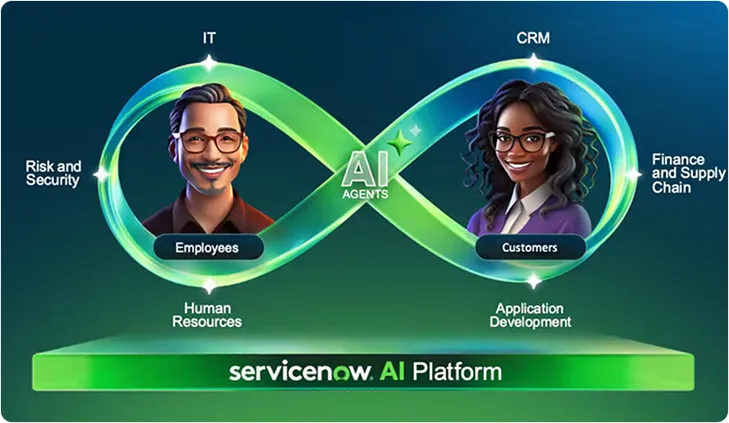
4. ServiceNow Document and Visual Insights AI Agent
ServiceNow's document agent extracts specific information, summarizes key topics, and answers questions from documents or images, integrating with service workflows for tasks like data retrieval and citation-backed results. Particularly effective for organizations using ServiceNow for ITSM or HR service management where document intelligence feeds workflow actions.
-
Best for: organizations running ServiceNow who need document intelligence
embedded in service workflows
-
Strength: ServiceNow ecosystem integration, citation-backed answers, workflow
connectivity
-
Limitation: strongest value for ServiceNow-centric environments
5. GoSearch AI Agents — Best for Enterprise Document Search
GoSearch provides enterprise search agents that index documents, deliver citation-backed answers via RAG, and generate artifacts like PDFs or spreadsheets from document insights. Role-based security ensures agents only surface documents that users are authorized to access.
-
Best for: enterprise knowledge search across large document collections with
strong security requirements
-
Strength: citation-backed answers, role-based permissions, artifact generation
from insights
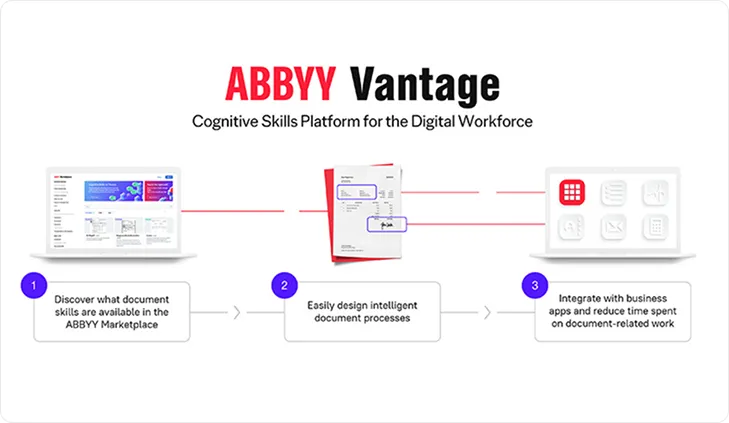
6. ABBYY Vantage — Best for Business-Ready Extraction
ABBYY Vantage is positioned as a business-ready intelligent document processing platform with pre-built agents for invoices, purchase orders, and other common document types. Strong foundation in OCR and structured extraction with validated outputs for high-compliance environments.
-
Best for: enterprises needing validated, business-ready extraction from standard
document types
-
Strength: OCR accuracy, compliance-ready outputs, pre-built document type
support
Frequently asked questions
Published Articles
Why Do Enterprises Struggle to Use AI Agents Effectively?
What Causes Data Retrieval Agents to Miss Important Insights?
How Do Conversational AI Agents Improve Decision Making with Unstructured Data?
Which AI Agents Are Best for Enterprise Data Analysis?
What Is the Best Conversational AI Agent for Sales Teams?
Which AI Data Agents Help Enterprises Unlock Insights from Documents?
What Are the Top Enterprise AI Agents for Knowledge Management?
Which Generative AI Agents Streamline Internal Workflows Across Large Companies?
What Is the Best AI Agent Platform for Unstructured Data?
Which AI Agents Enable Human-Like Dialogue Over Company Data?
What is No-Code Precision AI?
Best Conversational AI Sales Agents Compared
See Ragworks in action
Stop guessing. Simulate your entire outbound playbook before hitting send.
Watch demoThere is more
to discover
Read relevant article about AI, Ragworks and our
Founders. You can also find more article on our article

April 1, 2026
Why Do Enterprises Struggle to Use AI Agents Effectively?
Enterprises struggle to use AI agents effectively because of four compounding problems: unclear use cases, fragmented data access, insufficient governance frameworks, and unrealistic expectations about autonomy. The technology is rarely the limiting factor. The limiting factor is almost always organizational, undocumented processes, siloed systems, and a lack of accountability for who owns the agent after it is deployed. Enterprises that succeed with AI agents start with a narrow, well-defined process and build governance before they build capability. Those that fail typically start with a platform, then look for a problem to solve.

April 3, 2026
What Causes Data Retrieval Agents to Miss Important Insights?
Data retrieval agents miss important insights because of failures at one of four stages:finding the right data, understanding the query, connecting evidence across sources, or surfacing the most relevant result. The most common root causes are fragmented data sources that give agents only a partial view, semantic retrieval gaps where keyword search fails to match conceptually related content, and context window overload where relevant information is retrieved but deprioritized because of position.These are not random failures. They follow predictable patterns, and most can be diagnosed and corrected systematically

April 6, 2026
How Do Conversational AI Agents Improve Decision Making with Unstructured Data?
Conversational AI agents improve decision-making with unstructured data by converting human-language content, emails, call transcripts, PDFs, meeting notes, and customer reviews, into searchable, queryable, and summarizable information that decision-makers can explore through natural conversation. Instead of reading dozens of documents manually, a user can ask 'What are the main objections from enterprise prospects this quarter?' and receive a synthesized answer with source references in seconds.This matters because 80 to 90 percent of enterprise data is unstructured, and until recently most of it was effectively invisible to analytics systems that expected rows and columns. Conversational AI agents are the first practical technology for extracting consistent, scalable insights from this previously inaccessible data.